
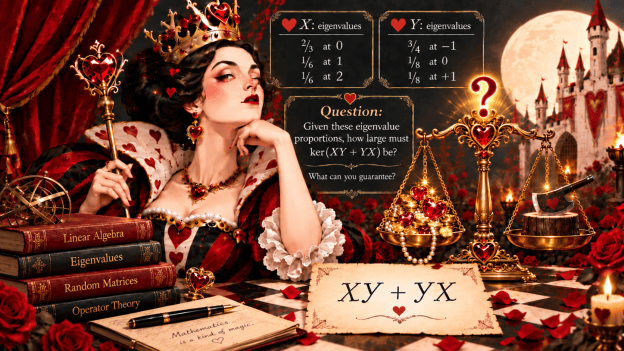
Suppose the Queen of Hearts offers you the following game.
She gives you two symmetric matrices and , and tells you their eigenvalues, counted with multiplicity — but not their eigenvectors. She also tells you a polynomial , and asks you to guess what fraction of the underlying space must belong to the kernel of . If your guess is not larger than the actual fraction, the Queen pays you your guess in gold. But if you overestimate it: off with your head. Is there any strategy to survive this for sure and to get out as rich as possible? Let’s say, I don’t even tell you the size of the matrices and only give you the proportions of the eigenvalues, like:
the first matrix X has 2/3 of its eigenvalues at 0, 1/6 at 1, and 1/6 at 2;
the second matrix Y has 3/4 of its eigenvalues at -1, 1/8 at 0 and 1/8 at +1.
What is your guess for the size of the kernel of the anti-commutator P(X,Y)=XY+YX? To be on the safe side you can of course always choose zero; this lets you survive in any case, but it won’t make you rich. Is there a better guess, which still guarantees you keep your head?
My answer is 5/12. In other words, you can safely bet that the dimension of the kernel of XY+YX is at least 5/12 of the dimension of the matrix, and, remarkably, you cannot make any larger universal bet.
At first sight this seems like a rather peculiar problem in linear algebra. The spectra of and tell us nothing about their relative eigenvectors, and depends very much on those eigenvectors. So how can one find the best possible lower bound, valid for every relative position?
Here free probability enters in a somewhat unexpected way. The main result of our work with Octavio Arizmendi, Guillaume Cébron and Sheng Yin says, roughly speaking: Put the matrices in free position. Then the eigenspaces of a polynomial in them are as small as they can possibly be.
Heuristically, freeness corresponds to putting the eigenspaces into maximally generic relative position. Thus a deterministic worst-case problem is solved by putting the variables in free position. More precisely, if we prescribe the sizes of the eigenspaces of the individual variables, then freely independent variables realize exactly the minimal sizes of eigenspaces that are unavoidable for every possible realization. Thus freeness does not merely describe some convenient or random situation: for this question it describes the extremal generic situation.
If you want to see where the mysterious 5/12 comes from, for our particular anti-commutator there is even an explicit formula. Let
- t be the proportion of zero eigenvalues of ,
- s the proportion of zero eigenvalues of ,
- u the largest proportion of any non-zero eigenvalue of ,
- r the corresponding largest proportion for .
For freely independent and , the mass at zero of is max(2t-1, 2s-1, s+u-1, t+r-1, 0). And our universality result tells us that this is precisely the best lower bound which can be guaranteed from the spectral information alone.
In the example above, t=2/3, s=1/8, u=1/6, r=3/4, so the five candidates for the maximum are 1/3, -3/4, -17/24, 5/12, 0; the winner is indeed 5/12. So the Queen pays — and your head remains where it belongs.
The phenomenon is much more general: it works not only for this anti-commutator, and not only for polynomials, but also for non-commutative rational functions. The details are in our paper with Octavio Arizmendi, Guillaume Cébron and Sheng Yin, Universality of free random variables: Atoms for non-commutative rational functions, now published in Advances in Mathematics 443 (2024), 109595; for the arXiv version, see here.
And, if you want one more bet before leaving the Queen’s court, keep as above but change
the eigenvalues of to 1/2 at -1, 3/8 at 0 and 1/8 at 1.
How much can you safely bet this time? Feel free to leave your answer in the comments.

